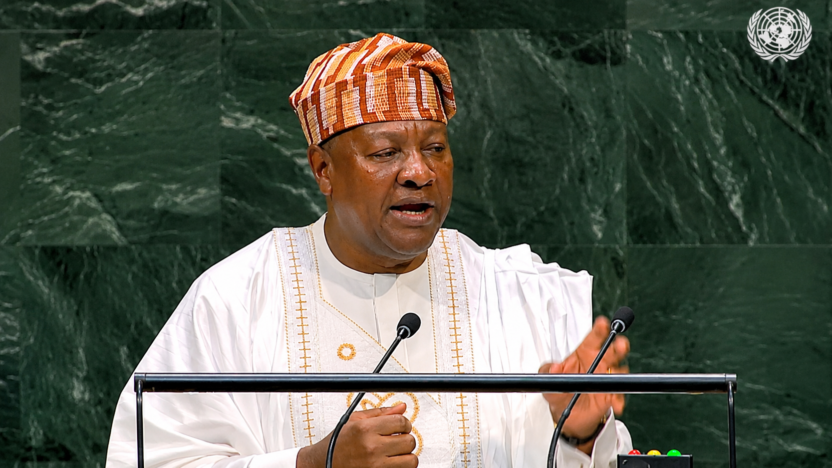
When President John Dramani Mahama stepped before the United Nations General Assembly on 24 September 2026, he began not with a policy announcement, but with a reminder of where he came from. His birthplace, his parents, the languages he speaks and the words of Ghana’s national anthem became the foundation for a wider argument about justice, belonging and the future of the global order.
Addressing the 81st United Nations General Debate, Mahama challenged world leaders to confront historical injustices, reconsider Africa’s place in international decision-making and respond more fairly to the economic and environmental crises facing developing countries. His message was clear: Africa is not asking to be rescued. It is asking to be treated as an equal.
From Ghana’s national anthem to the question of belonging
Mahama opened by congratulating Khalilur Rahman of Bangladesh on his election as President of the 81st session of the UN General Assembly. He then turned to Ghana’s national anthem, particularly its call to defend freedom and righteousness with courage and honesty. The prayer, he explained, inspired him to speak frankly about the state of the world.
He also reintroduced himself beyond the title of president. Born in Damongo to Emmanuel Adama Mahama of Bole and Abiba Nnaba Suluwu of Busunu, he described growing up among different Ghanaian cultures and speaking languages including Gonja, Akan, Ga and Hausa. Language, in his account, is more than a means of communication. It carries memory, identity and belonging.
But belonging can also be weaponised. When political leaders turn identity into a tool for exclusion, it can fuel xenophobia, discrimination, displacement and conflict. His central point was uncompromising: no child’s life should be worth less because of their language, faith, skin colour or birthplace.
Reparative justice: recognising the legacy of slavery
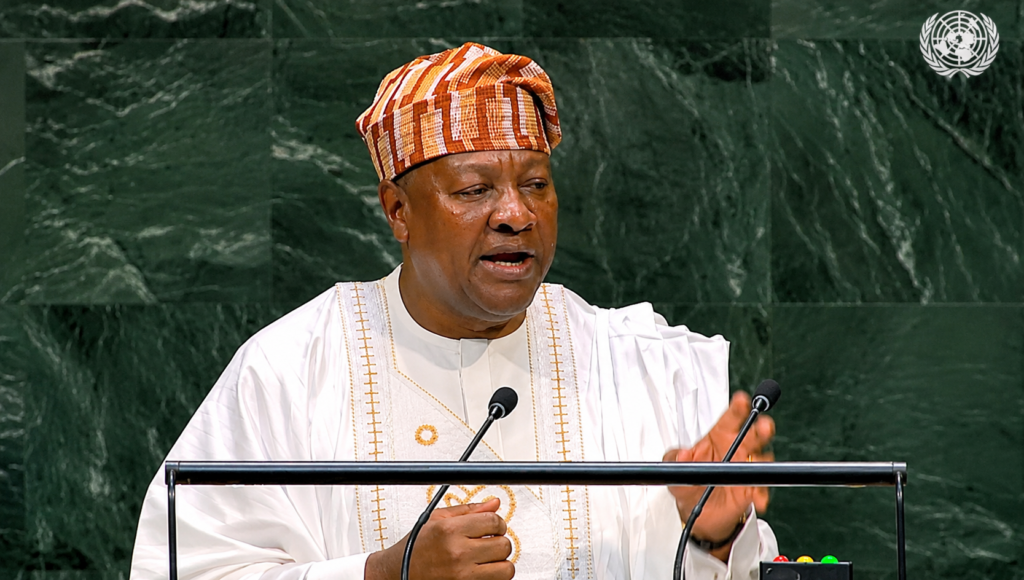
One of the speech’s most significant themes was Ghana’s campaign for international recognition of the transatlantic slave trade and the racialised enslavement of Africans as the gravest crimes against humanity.
Mahama recalled the UN resolution introduced by Ghana on 25 March 2026, the International Day of Remembrance of the Victims of Slavery and the Transatlantic Slave Trade. He said 123 countries voted in support and thanked the nations that backed the resolution. He also welcomed moves by the Netherlands, Germany and France to join discussions on reparative justice and restitution.
For Mahama, however, recognition cannot end with a resolution. Reparative justice must also address the economic structures that continue to disadvantage African countries, including unequal trade arrangements, resource extraction, discriminatory credit assessments and unsustainable debt. The argument is that history does not exist separately from the present. Its consequences can still be seen in who controls wealth, who benefits from production and who carries the costs of global inequality.
Why Africa wants a permanent seat on the UN Security Council
Mahama challenged what he described as the contradiction at the heart of global governance: Africa represents more than 1.5 billion people and constitutes the largest regional voting bloc in the General Assembly, yet has no permanent seat on the UN Security Council. He called for permanent African representation, including the rights and responsibilities held by existing permanent members.
The demand goes beyond symbolism. Decisions made by the Security Council can shape international responses to wars, sanctions and threats to peace. Africa’s lack of permanent representation raises questions about whose interests are reflected in those decisions. Mahama connected this imbalance to the financial system, arguing that developing countries can face borrowing costs up to eight times higher than industrialised nations. Countries already dealing with floods and droughts, he said, are often forced to borrow to rebuild after disasters they did little to cause.
His position was direct: Africa does not seek charity. Africa seeks equal partnership.
From extracting African resources to creating African wealth
The speech also addressed the way Africa’s natural resources enter global supply chains. Mahama warned against a new scramble for the continent’s minerals, particularly those needed for the global energy transition. Exporting raw materials while processing, manufacturing and higher-value employment happen elsewhere leaves African economies with only part of the potential benefit. He argued that countries should process more minerals at home, develop local industries and create jobs for young people.
The African Continental Free Trade Area, whose Secretariat is based in Accra, featured as part of this ambition to expand trade within Africa and strengthen regional industrial development. The challenge is not simply to extract more resources. It is to retain more of the value they generate.
Gaza, Cuba, terrorism and the climate crisis
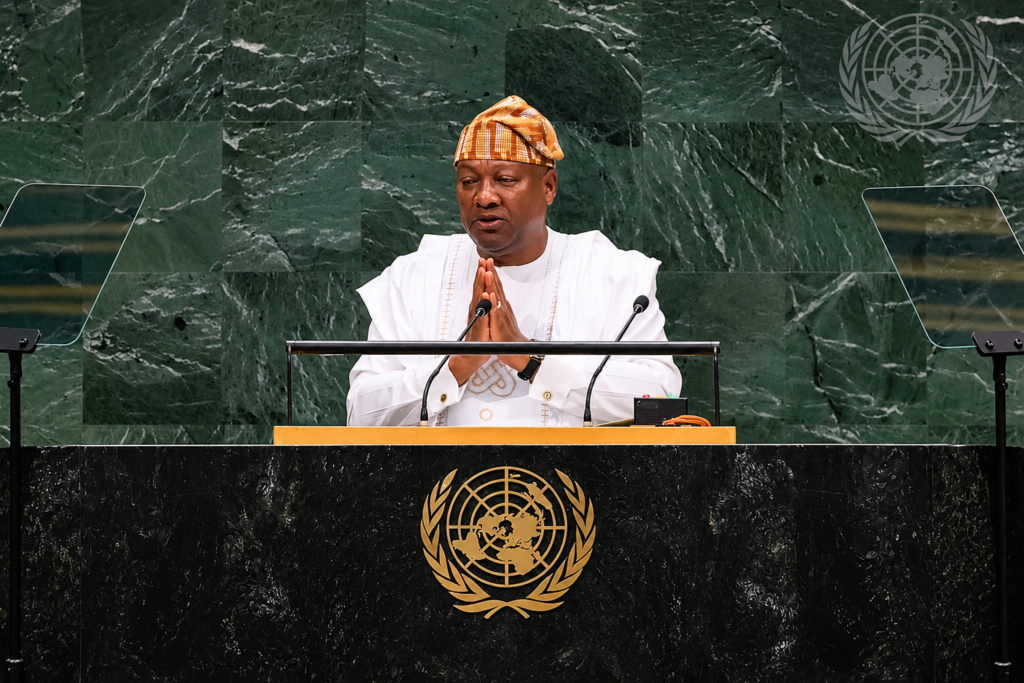
Mahama called for an end to the persecution of Palestinians in Gaza and the West Bank, reaffirming Ghana’s support for Palestinian statehood and a two-state solution. He condemned acts of terrorism by Hamas and urged all parties to respect international humanitarian law. He also reiterated Ghana’s call for the lifting of the decades-long economic, commercial and financial embargo on Cuba, while highlighting the humanitarian crisis in Sudan and the threat of terrorism in the Sahel.
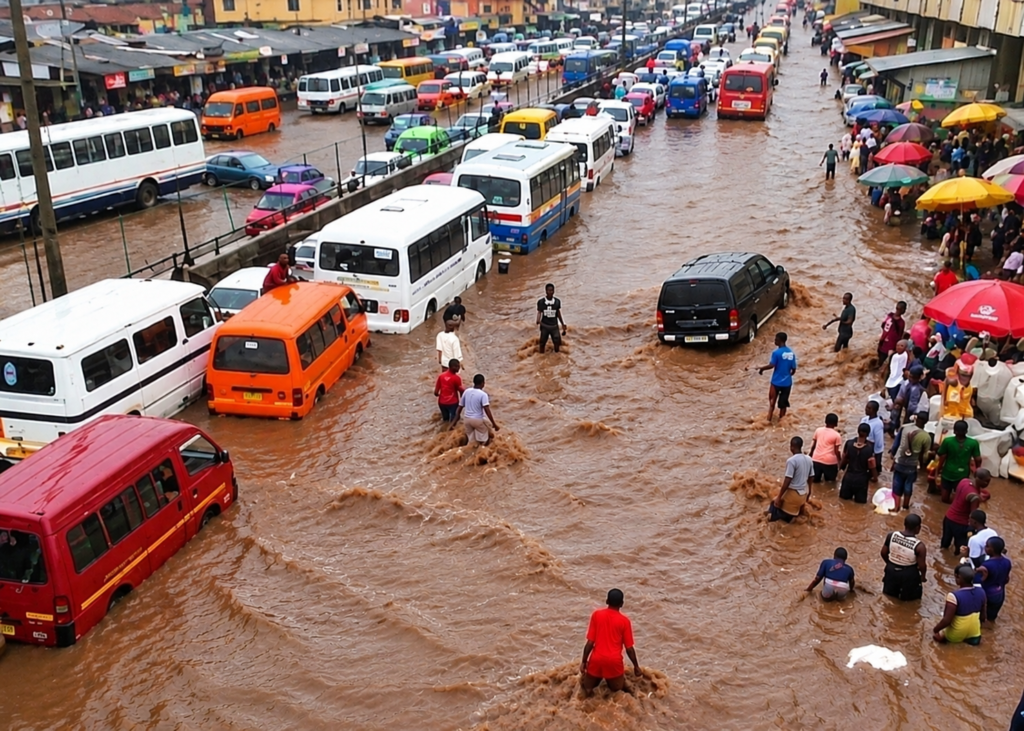
Climate change brought the global argument closer to home. Referring to the devastating floods of 29 June 2026, Mahama cited more than 160 millimetres of rainfall across seven coastal regions within 24 hours, with 39 deaths and one person reported missing. He argued that climate-vulnerable countries should receive predictable financial support through grants rather than additional loans that deepen their debt. The point was particularly relevant to Ghana: when disasters strike, recovery requires resources, infrastructure and resilience. Those costs become harder to bear when countries must borrow heavily to rebuild.
Ghana’s domestic agenda: the economy, healthcare and democracy
Mahama also used the address to defend his administration’s domestic record, describing Ghana’s economic turnaround during his tenure of less than two years as evidence that disciplined governance could restore stability. He cited lower inflation, a more stable currency, economic growth and reduced public debt as signs of progress. These were claims made by the president in his address, rather than an independent assessment of every economic indicator. He highlighted the 24-Hour Economy and Accelerated Export Development Programme, designed to encourage round-the-clock commercial activity, increase value addition and create jobs.
Healthcare was another priority. Mahama referenced Ghana’s Free Primary Health Care Programme and the Ghana Medical Trust Fund, popularly known as MahamaCare, which supports people living with serious non-communicable diseases. He linked these policies to the Sustainable Development Goals, particularly the goals on poverty, health and reduced inequalities. Looking ahead, he pointed to Ghana’s planned chairmanship of the African Union in January 2027, presenting it as an opportunity to advance continental integration, peace and security, and a stronger African voice in global affairs.
The conclusion: a world built around shared humanity
Mahama ended where he began: with belonging. The refugee, the migrant, the child living through conflict, the descendant of enslaved Africans seeking justice and the community protecting its ancestral environment all belong to the same human family, he argued. Drawing on Kwame Nkrumah’s vision that Ghana’s independence must be linked to the liberation of Africa, Mahama extended the principle to the wider world. No country’s freedom or prosperity is secure if it rests on the exclusion of others.
The address offered a vision of international cooperation grounded in justice, equal partnership and shared responsibility. Whether these commitments translate into lasting change will depend on what governments do after the speeches end. For Africa, the questions remain urgent: who controls its resources, who represents its people in global institutions, and who pays when crises strike? The United Nations General Debate provides a platform for those questions. The real test is whether the international community is prepared to act on the answers.
Follow for more coverage of Ghanaian politics, African affairs, culture and the issues shaping our shared future.