Edwin Adokwei Boye is a Ghanaian visual artist whose work explores the relationship between waste, memory, and human experience. Working between Afro-surrealism and sustainability, he turns discarded textiles into layered visual stories that make us rethink what we value, what we throw away, and what can be given new meaning. Rather than treating waste as an endpoint, Adokwei approaches it as a material archive. His practice draws attention to the lives embedded in secondhand clothing, garments that have traveled across borders, passed through markets, and ended up on beaches and landfills in Accra.
Through digital art and material manipulation, image transfer, and painting, he repositions these textiles as reminders of where they’ve been and where they’ve ended. His work is grounded in process, research, and lived observation, offering a firm critique of global consumption.
A Self-Taught Journey Shaped by Curiosity
Adokwei’s journey into art didn’t begin in a classroom or studio. It began with curiosity, experimentation, and time. Lots of time. Like many self-taught artists, he learned by doing; by trying, failing, adjusting, and returning to the work with persistence.
When I asked him what first drew him into this world, he spoke about manipulation; not in a negative sense, but as a creative act. He talked about sourcing images from the internet, experimenting, and seeing how far they could stretch. The first photographs he ever manipulated were of himself.
He laughed as he remembered working on his sister’s old, barely functioning laptop, adding a dragon to the sky of a photograph and feeling something shift. “I fell in love with it,” he said. From there, the work deepened, especially during and after his university years, as digital experimentation turned into a discipline rather than a hobby.
What stands out in Adokwei’s story is not just talent, but consistency. He compared consistency to going to the gym: a familiar reference between us, since he’s been “about to start” for as long as I’ve known him. You show up, you repeat the motion, and over time, something changes. That quiet repetition is still visible in his work today.
Afro-Surrealism, Memory, and the Influence of Salvador Dalí
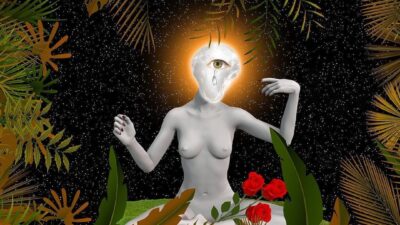
Adokwei’s work leans into surrealism, not as an escape from reality, but as a way of bending it so deeper truths can surface. I hadn’t known about Salvador Dalí until Adokwei mentioned him to me. When Adokwei showed me Dalí’s works, everything clicked. I could clearly see what he had been drawn to, the dreamlike quality, the way familiar things feel slightly off, almost unsettled.
For Adokwei, surrealism is also about placement and visibility. He explained that he often uses black people in his work because he wants to place them in spaces people never imagined they could exist or belong. In doing so, he grounds surrealism in culture and everyday life, using lived experience to challenge ideas of who gets to be seen, imagined, and remembered.
Working With What the World Throws Away
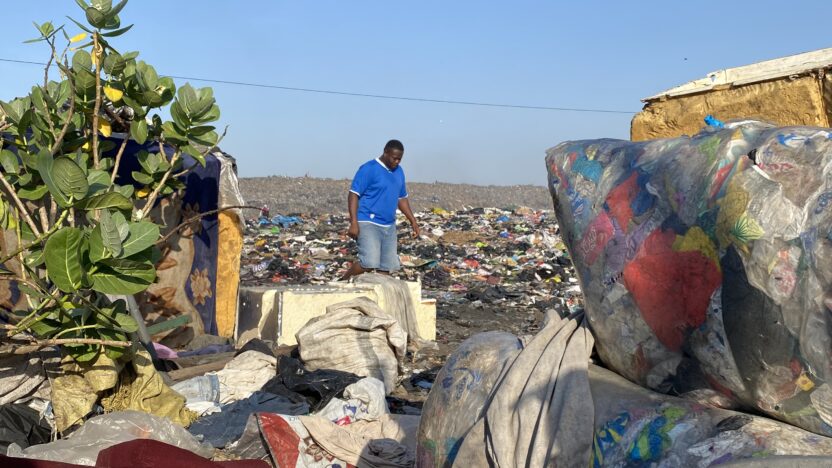
At the core of Edwin Adokwei Boye’s practice is textile waste, sourced from the beaches of Accra, Kantamanto Market, and the Agbogbloshie landfill. These are not neutral materials. They are charged, heavy with meaning.
Each piece of fabric once belonged to someone. It was worn, washed, stretched, and eventually discarded. To Adokwei, these textiles are not rubbish; they are carriers of memory, displacement, and human movement. “I get excited about transformation,” he once told me. “When I see waste on the beach now, all I see is a new fabric for an artwork.” That shift in perception is central to his work. What others overlook, he reclaims.
© Maria Hernanglez
Art Beyond Aesthetics: Sustainability and Environmental Reality
Adokwei’s concern extends far beyond visual beauty. His work speaks directly to environmental damage and the global systems that enable it. Research shows that many discarded clothes are made from microplastics, releasing harmful chemicals into aquatic environments once they enter the ocean. For fishing communities along Ghana’s coast, this is no abstraction.
Fishermen increasingly pull textiles from the sea instead of fish, forcing them to travel farther for smaller catches. Adokwei’s work sits with this reality-asking viewers to reconsider their relationship to consumption and waste.
His belief is simple but powerful: if everyone picked up just one piece of trash from the beach, something would change. His art gives form to that idea, offering transformation instead of despair.
MuseumsQuartier Wien and a Growing Ghanaian Presence
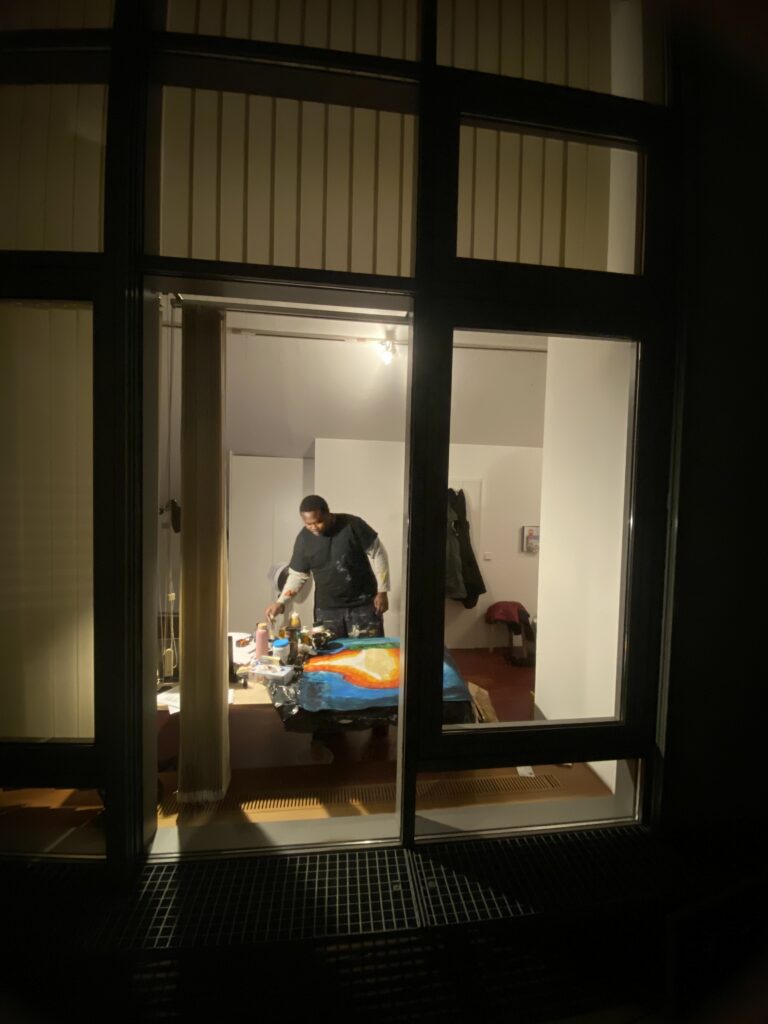
The news of Adokwei’s residency at MuseumsQuartier Wien (MQ) arrived unexpectedly. I was at work when my phone buzzed: a message from Edwin. In that moment, joy came without warning. There was laughter and disbelief; a quiet attempt to hold on to the present before the weight of the news settled in.
MuseumsQuartier Wien is one of the largest cultural districts in the world, spanning over 90,000 square meters and housing around 60 institutions. It brings historic Baroque architecture into conversation with contemporary art, creating a space where fine art, performance, architecture, design, literature, and experimental culture flow into one another.
In recent years, the MQ has become an important site for African contemporary art. Ghanaian artist Ibrahim Mahama’s landmark exhibition Zilijifa at Kunsthalle Wien marked a significant moment, foregrounding narratives of labor, material history, and postcolonial infrastructure.
Before Adokwei, Razahk Issaka became the first documented Ghanaian artist to participate in the MQ Artist-in-Residence programme in December 2023, working on Zobe, an animated fantasy project rooted in African storytelling. Adokwei now follows as another Ghanaian voice in this evolving dialogue, tracing the journey of discarded clothing as it moves between Europe and West Africa; between places where things are consumed and the places where the consequences are felt.
© Marlene G. Prinz
Discarded Stories: Where Fabric Becomes Memory
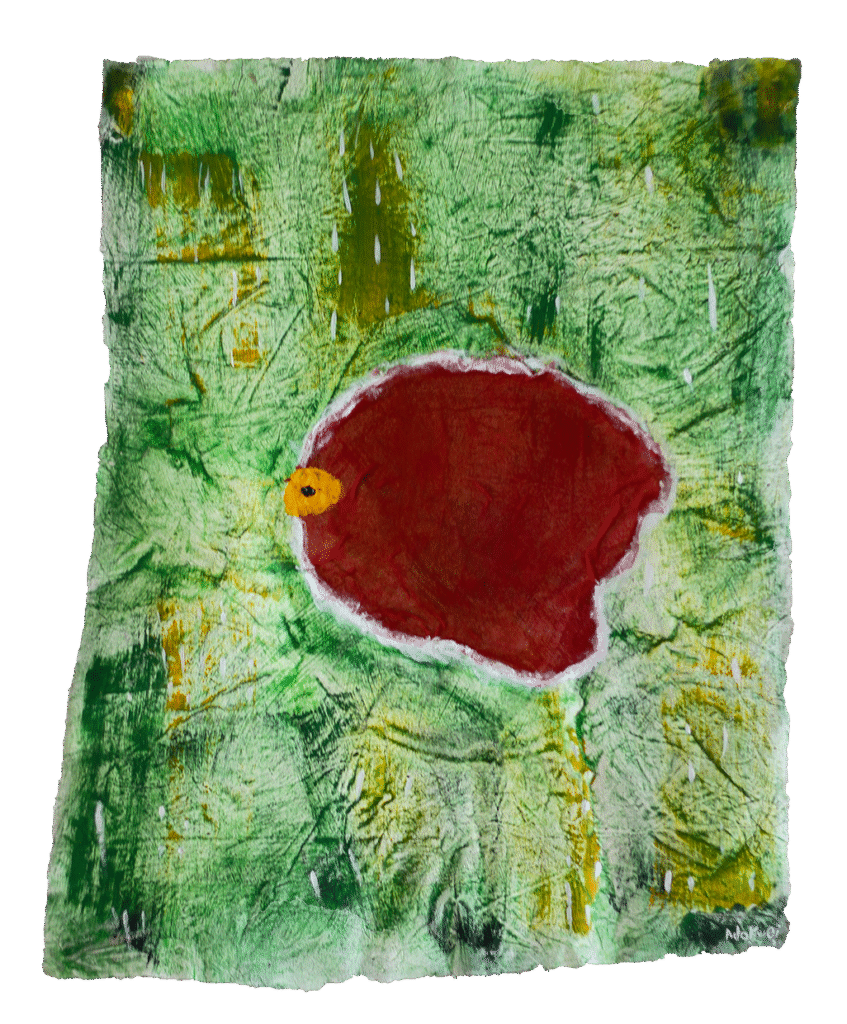
One of my favorite bodies of work by Adokwei is Discarded Stories; a series that demands attention the moment you encounter it. There is no chance of walking past these works without stopping.
The paintings draw you in quietly. The surfaces are firm, almost sculptural, built by layering glue beneath the paint so the fabric holds its shape. The colors sit boldly on the surface, catching light in subtle ways. Nothing is smoothed over.
In Discarded Stories, Adokwei turns textile waste into materials that hold memory and meaning. Each piece of fabric comes from a life once lived, even if its full story is unknown. The paint settles into the fabric, bringing the paint and fabric together.
Reimagining Waste, Reimagining Value
Ultimately, Adokwei’s work is about possibility and hope. It asks what happens when we stop seeing waste as an endpoint and begin to see it as a beginning. His art does not offer easy answers, but it does offer transformation. By turning discarded textiles into art, Adokwei reshapes how we think about sustainability and the quiet human stories embedded in everyday materials. His work invites us not just to look, but to reconsider how we live, consume, and remember.
If stories shape how we understand the world, then Adokwei gives each fabric a new story.